Tuesday, May 17, 2016

First Track Race (and Win!) at Dawn 2 Dusk 2 Dawn

I was trying to remember the last time I'd set foot on a track. I guess it was high school gym class, during the running unit, which I dreaded. And now, not too many years later, I voluntarily brought myself to a high school track and pledged to run around it for twelve hours straight. I was doing the 12-hour race at Dawn to Dusk to Dawn Ultras (just the Dusk-to-Dawn portion).


Now that I've done a few 100-mile races—and only the first of them was truly terrible, taking almost 32 hours—running for twelve hours wasn't a big deal. The whole running-around-a-track thing might have been really bad, boring, etc., or maybe not. That's what I wanted to find out—it's why I signed up back in January.

But I really wasn't feeling great about this run, on the day of. I played capture the flag with my Students Run team on Thursday instead of our shoulda-been easy few miles, and I was embarrassingly sore from the sprinting on a hot day. Then there was the whole 7pm start, which meant I wouldn't be running shortly after waking, but rather after I'd been up the whole day. I tried taking a midday nap, but I didn't get much sleep. And with being awake comes eating—I usually toe the line basically fasted with maybe a little food in my stomach, but today I must have had all sorts of stuff along the digestive party line. I tried to stick with easily digestible stuff—collagen-infused liquids, no fiber—but you never know. And then it was raining.

Still, it's not like I was going to not run, so I packed up my duffel bag at 4 and went to catch the 5:21 trolley out west. The trolley was 15 minutes late, which made me nervous—I was downloading the Uber app when it finally came. And then it was a 20-minute walk from the Darby Transportation Center to the high school in Sharon Hill. Trolley tardiness notwithstanding, this was the easiest commute to a race start I'd ever had!

In the rain I met Bill, one of the race directors, who checked me in and showed me around, and then I sat under a canopy until the 7pm start with some of the Valley Forge Military Academy cadets who were volunteering at the race.

Buckling down in the final hour. It was hard to keep myself running after I hit my goal of 100k... but there were 40 minutes to go! Photo by Israel Archuletta.

At 7pm the rain stopped and the race started. The track was splashy for the first few hours, so I stopped periodically to dry off my feet and sandals (I was worried about getting blisters). And at sunset they were having some trouble getting the track lights on, so we had some wonderful peacefulness in the dark for a while.

I really loved running around in circles. Wonder what that says about me. It was relaxing, mind-emptying, wonderful. I didn't have to pick out my footsteps or watch out for anything. I didn't have to worry about getting lost. It was regular, predictable—hard to come by in a sport characterized by its irregularity and unpredictability.

The thing I didn't like was how competitive it made me. When I run ultras, I never think about place or winning or whatever. I just focus on staying comfortable and strong the whole time—or as long as I can, at any rate. But at this race I could see my stats every 400 meters: how long that lap took me, how much slower it was than my previous lap, what place I was in, how far I was behind the next guy. I was in second place from the get-go, where I stayed for a few hours. But I was only 2–3 laps behind the leader, depending when you checked. And of course I could see him across the track at any given point, so it naturally became my mission to overtake him, like it or not. Once I did, around the fifth hour, I think, I was paranoid about losing my lead, which pushed me to keep running. I barely talked to anyone—also somewhat unusual for me, when it comes to ultrarunning—because for the most part our paces were so different, and because I didn't want to slow or speed even a little bit.

Things got tough in the deep night, so I put on music. I listened to an audiobook for a while, but I couldn't pay attention to it for more than an hour. My legs gradually became sorer, and my calf muscles were threatening to strain, and my feet were getting tender. I put on my calf-compression socks and kept going. There was nothing left in my brain to try and stop me, I guess. My stomach was a bit upset, too. (Good thing I didn't go for the pizza in the first hour, or things would have been even worse!) I tried eating things and I tried not eating things, and then I decided to just ignore it.


Sunrise, as usual, was rebirth. Though I wasn't as tired in the night as I've gotten during 100-milers, I still experienced a surge of energy when I saw it getting light out, and that energy stayed with me till the end.

In the end I completed 261 laps (almost 65 miles). My final lap was my fastest—1:48. Most laps were about 2:30, but the ones where I stopped to rifle through my bag or take a bathroom break were slower. Considering I don't feel 100% yet after my last 100-mile, and how I was feeling pretty sore starting out, I'm happy! (My main goal was 100k (62 miles), and my stretch goal was 75 miles.)

In any case, my performance was enough to get first place. It was the first time I'd ever won a race!

Cool handmade awards

And I have to say, it was inspiring seeing the 24-hour folks out there. Some of them (world record and/or Team USA contenders) were running faster than me, and they'd been going for twelve hours longer! I've got half a mind to sign up for the 24 next year to see how far I get...

Me at the awards ceremony, awards in hand. Photo by Israel Archuletta. As RD Bill Schultz keeps saying, "May your goals forever be in sight."

Chart of my lap times. You can see where I was getting pretty tired around the 50-mile mark, as well as after I hit 100k.


Monday, April 11, 2016

Zion 100 Mile

The thing about reading someone's race report is you can skip parts, jump around, skim. If you were actually running the race, on the other hand, you'd have no choice but to take every, last, step—in order, one at a time.

If I were a good enough writer, I'd be able to help you feel what it's like to run 100 miles. Sometimes I think it'd be possible to do such a thing. Not right now, though.

Of course, I could tell you about some things that happened on the run. I could relay the facts, give you the play-by-play.

To be sure, some really terrible things happened: In the first two miles—it was still dark, and I didn't have my headlamp—I nicked my big toe on a rock. I didn't think anything of it until I felt an unusual slippery warmth underfoot. I looked down and saw blood everywhere. I quickly stanched the wound with my bandana and carried on. The bandage came loose and I retied it, again and again. Later, around mile 20, I thought I was going to have to throw in the towel after experiencing a throbbing headache, debilitating leg cramps and the kind of drowsiness that rarely manifests at 10 a.m. I was on a 7.5-mile section of petrified sand dunes,* and the sun was beating down. And then I ran out of water.

As all ultrarunners know, though, things always get better. Some hilarious things happened. I tried taking a selfie once and I ran into a prickly pear bush (deservedly). Later I got to pee off a cliff, fulfilling the dreams of every 10-year-old boy. At one point I thought I was gaining on my friend Shaina, who was also running the race, and I said coolly, "Well, fancy seeing you here," to a young woman who turned out to be a complete stranger. She turned around and said, "Oh, hey! How's it going?" To which I, still coolly, just said, "Oh, good. See you later!" and cruised on ahead. Around mile 52 my mom showed up with McDonald's, which I hadn't eaten in years, and so I had part of a cheeseburger because why not. One of the best parts of the race was running a six-mile dirt road in the dark; the terrain was easy enough that I didn't need to see, so I turned off my headlamp for a while and walked among the stars. It was incredible.

But still, it probably took you like one or two minutes to read those paragraphs.

Based on that, can you really wrap your head around what it's like to keep moving, from dawn to dusk to dawn, climbing mesa after mesa in the southern Utah desert? Being subject to the whims of the desert weather, knowing you need to eat but worrying it'll upset your stomach even more, trying to remember, again, why you do this to yourself. Stopping at an aid station at mile 85 and, from under the canopy, feeling the rain evolve into a torrential downpour and waiting to see if it'll let up soon or if you'll have to go out in it—when that cot in the corner is calling your name.

Maybe the only way you can really know what that's like is by doing it.

But why? I think there's tremendous value in ultrarunning, the nature of which I am still trying to unravel. (Indeed, it's part of my academic research.) I have to concede that it's probably not for everyone, but I do think virtually everyone can do it. (As much as I get lambasted for suggesting as much.) 100 miles is far, but it's not that far. It's hard, but it's not that hard. It doesn't take great athletic ability, per se, but rather a peculiar mix of smarts and idiocy. You have to be dumb enough to sign up but smart enough to finish. If you want to be reductionistic about it, running 100 miles is a series of thousands of micro-decisions. It's cognitively taxing, probably more than it is physically taxing. It's not about exerting yourself physically—rather, it's a practice in coming to grips with a seemingly-endless low-level discomfort. It's hard, but it's not that hard. This paragraph probably seems absurd to people who aren't already ultrarunners, so I'll stop it here.

On that note, I'm not sure where this "race report" is going, so I'll wrap it up. I'd like to give huge thanks to my mom who came out to support me on this little adventure. And to Max and Shaina, who it was great hanging out with before, during and after the run.

P.S.: If you want to get something of the ultrarunning experience without leaving your seat, just keep rereading this post for the next 26 hours. For added depth of experience, go outside, preferably while it's raining.

* * *

*The locals call this "slickrock," but I call it "spacerock." It's found on top of some of the mesas. It's basically an enormous undulating rock with holes and chasms all over the place. Like running on an asteroid. (Go back up.)


Click photos to embiggen.

The expo

Ascending the Flying Monkey mesa at dawn. Even with my toe bleeding prodigiously, I couldn't help but ogle at the view. Sprawling mesas in every direction, and a parade of headlamps like fireflies.

A bit higher up Flying Monkey

Fortunately it was cloudy for most of the day. The high-sun parts were barely tolerable. If it were sunny the whole day, I'm not sure I would have finished.

Around mile 14 cruising on some flat areas

One of the course's smaller ascents

Thought I should have a self-portrait from the race. Shortly after taking this photo was my run-in with the nopal.

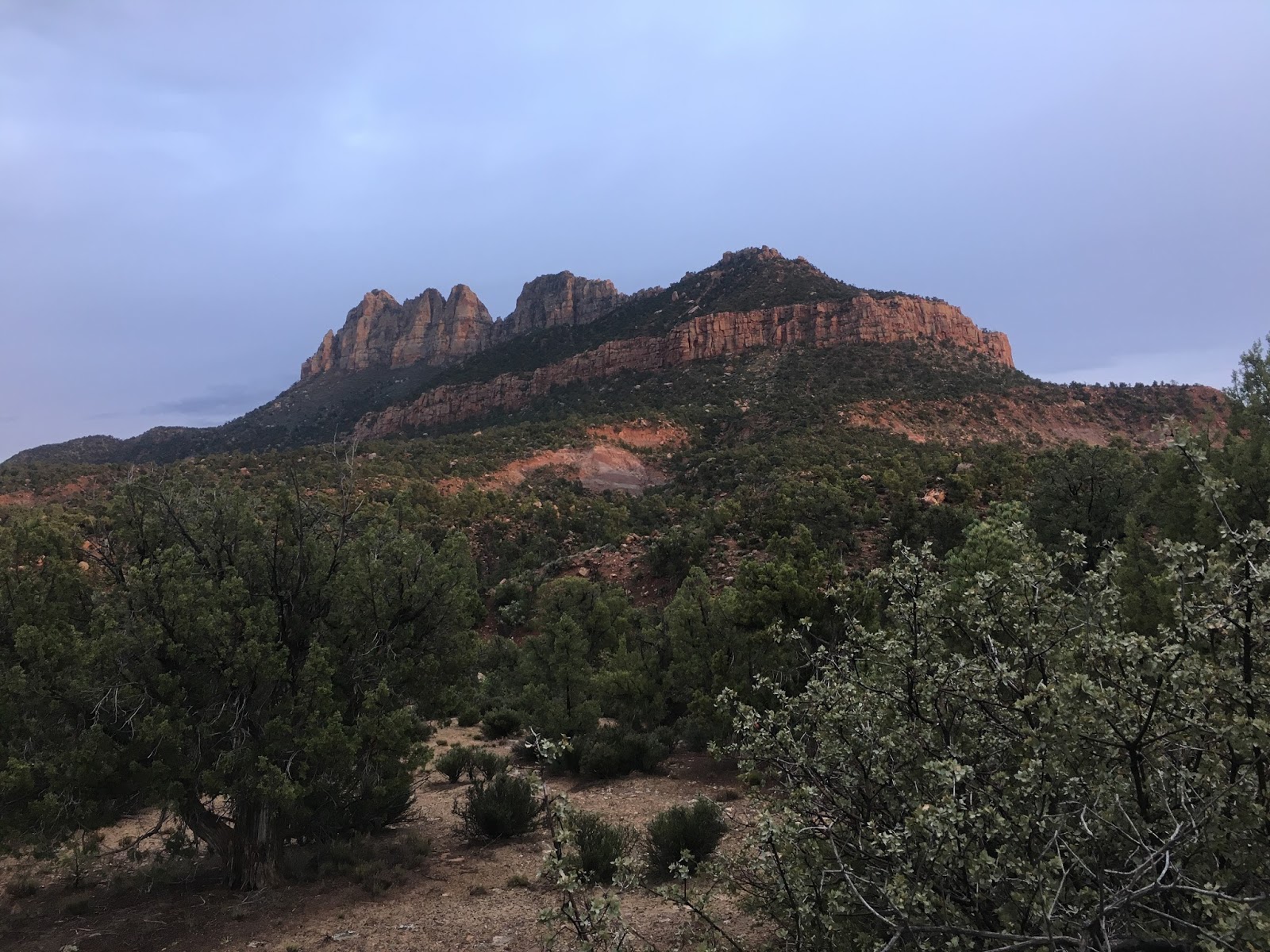
The photos don't do justice to the striking scenery. We were running among these ancient mesas for the whole course—perhaps that's why I was so out of breath.

The race was right in time for the first wildflower blooms. Amidst the red clay and greenish shrubbery were here-and-there explosions of yellow, red and purple flowers.

Looking down from the edge of Guacamole Trail

I used to be down there, but now I'm up here!

A decent view of slickrock. This is the Guacamole Trail. Look for the teeny tiny people in the center of the photograph for scale.

Red rocks!

Ascending Goosebump. This was the steepest and longest climb of the race. It made me so grateful I'd been doing barbell squats and deadlifts. Again, look for the tiny person up the trail.

Looking down from the Goosebump climb (Gooseberry Mesa), and this isn't even all the way up!

Same view as the previous picture, but now from all the way up. This gives you a sense of the climb. Yowza. 

After ascending Goosebump, we ran a 12-mile roundtrip trail out to Gooseberry Point. A.k.a. more spacerock. This view made me feel like I was in Jurassic Park. So not only did I have to be afraid of running into elk or mountain lions, but I was afraid of velociraptors.

Cool tree!

At the very edge of Gooseberry. Hey, it's Clare!

Hanging out at Gooseberry. Stopped for the photo this time to avoid any cactus encounters.

Another view from Gooseberry

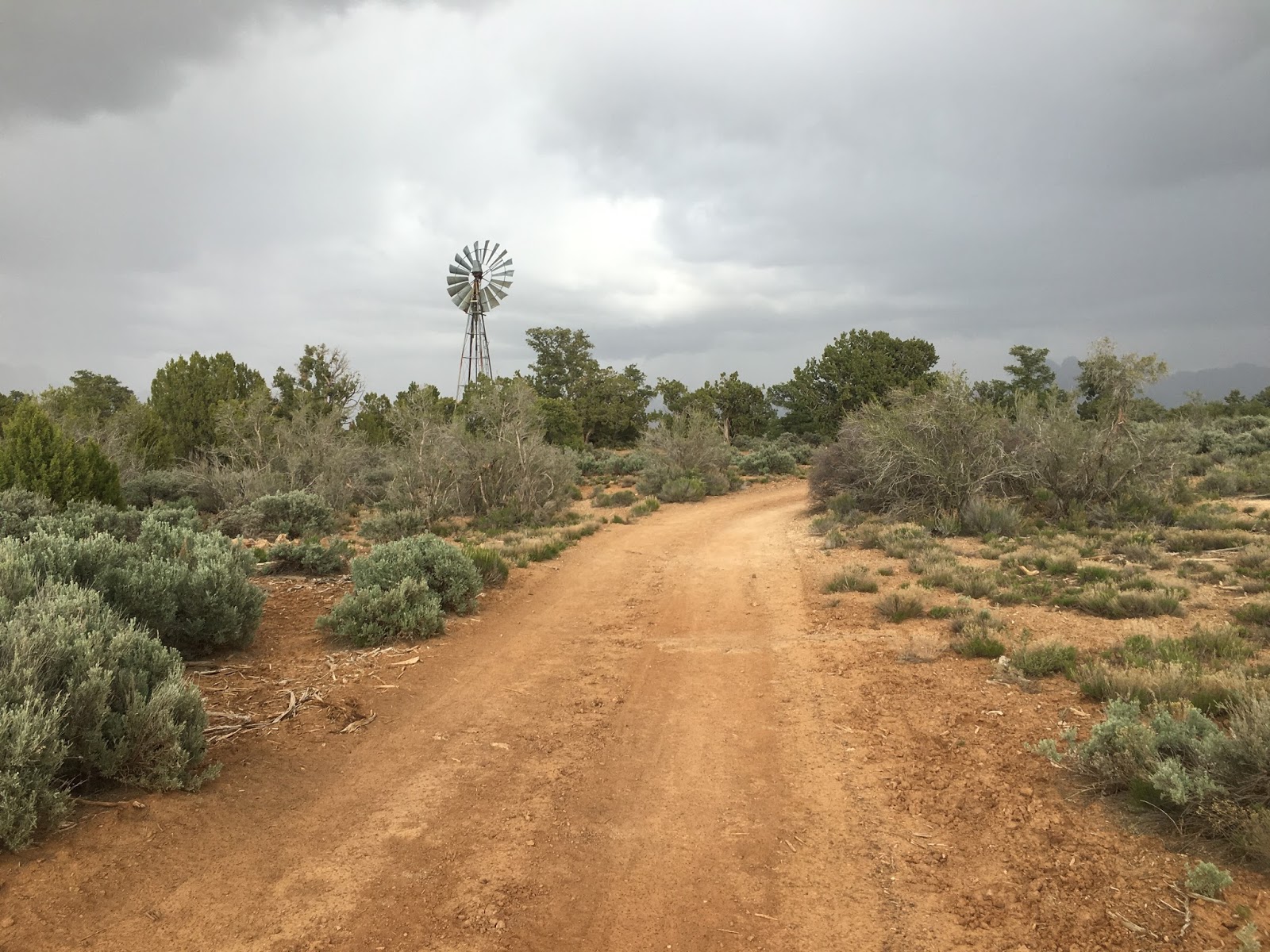
Near the end of the Gooseberry loop, heading back to the Goosebump aid station, around mile 46. Came across a random windmill. Made me think I was going crazy like Don Quixote.

Looking toward Zion around mile 50. The sun is setting.

This is what it's like running at night. Picture running like this for 9 hours when you're already tired. Some of those rocks look quite like pillows. 

After the maddening nighttime rains, the final six-mile stretch was a muddy mess. 

Sunday, February 28, 2016

Running as information

We're in the heyday of the concept of information. We talk about almost everything these days in terms of information. And this can be a useful perspective sometimes. For instance, a longstanding maxim equated food with fuel; but over the past few years, there's been a shift toward seeing food as information instead. This view helps us see food not simply as uniform calories, but as conglomerations of macronutrients, micronutrients, phytochemicals and zoochemicals. This view also helps us understand food as a political statement, emotional tanner and intimacy substitute.

What if we thought of running as information? What might this perspective help us to see?

In a recent research paper, I did just that. (When I'm not running, I'm a PhD student in information science.) My paper Information on the Run: Experiencing Information During an Ultramarathon, published in the open-access, peer-reviewed journal Information Research, explores the information processes at play that I experienced while running my first 100-mile race. Here's what I found:

  • Though ultrarunning is an individual sport, it has an important social component. Things like trail etiquette and appropriate gear are socially controlled. The ultrarunning community is orally-based, is centered around public performances (races), recognizes a few key information sources (e.g., UltraRunning Magazine, Trail Runner Nation podcast, the ULTRA listserv, Hal Koerner's and Bryan Powell's guides, Garmins, etc.), and above all seems to value perseverance. These shared characteristics offer cohesion to the ultrarunning community, making it much more than an individual pursuit. 
  • During an ultra, the key information source is the body. In the research literature, this type of information is known as corporeal information. This includes, for instance, gauging my hunger and thirst, deciding whether I can run through a cramp and detecting blisters. Working with corporal information can be understood as a kind of "literacy" that ultrarunners cultivate as they gain expertise in the sport. Though it may be the case that external technologies can support this process (e.g., some runners set their watch to beep every 30 minutes, cueing them to take a sip of water), much corporeal information management seems to be unconscious and internal. Future research should tease apart these processes more.
  • Another key information source is the runner's knowledge base, in which memories of training runs and internalized books, podcasts, advice, plans, etc., coexist and are called up in response to any number of stimuli during a run. For instance, I felt nauseous and disoriented during my first 100-mile run, and I searched my knowledge base for possible solutions. 
  • On the run, corporeal information and the knowledge base interface in a feedback system of outcomes and mental states. For example, I might sense some calf pain (corporeal information), which makes me worried (mental state); I recall how it was previously injured but that even so in a recent race I felt this same pain and it ended up being a false alarm (knowledge base), which causes me to keep going despite the pain (outcome), and also makes me feel a little better (mental state). If the pain persists, I might check in again a little later, running through the process again. 

In this way, seeing running as information helped uncover some interesting aspects of ultrarunning: the importance of the social aspect of running, and the processes that help and athlete cope with covering such long distances. And, most importantly, this brings up a number of questions for future study. For me, the most interesting has to do with novices versus experts—how do beginners manage information differently from more experienced ultrarunners, and how can that knowledge help us teach or coach beginner runners?

My future research will continue to explore these questions, and I invite others to join me.


Friday, January 8, 2016

Second 100 Mile at the Pistol Ultra Run

This weekend I ran my second 100-mile at the Pistol Ultra Run near Knoxville, Tennessee. It went almost better than I could have hoped, in some respects. I finished in 22 hours, 22 minutes, which was somewhat slower than I was hoping... but considering I wasn't feeling 100% going into it, I'm satisfied. More importantly, I felt pretty much even energy the whole way, with no real downs. In that respect, it was perfect.

This post tells a bit of the story, along with key lessons and strategies.

Lead-up: Marathons As Training Runs

I ran the Philadelphia Marathon on November 22. I was hoping to BQ, but hills, wind and tremendous blood blisters made sure that didn't happen. I started out well, but my pace slipped: at the 10k, my average pace was 6:53/mi; by the half, it was 7:05; by 30k, 7:17; and at the finish, 7:37. Finishing in 3:19 was still a PR, but I couldn't help but feel a little bummed because I knew I could have done better if I hadn't gotten the blisters. So I signed up for the Kiawah Island Marathon on the coast of South Carolina a few weeks later, on December 12. (The blisters boggled me because I never get them. Then again, I never run that fast for that long...)

  
Post–Philadelphia Marathon. Just so you can see I'm not kidding about those blood blisters. Look at the size of that one!

In the meantime I managed to screw up my calf: A quarter-mile into one of my training runs, I felt a sudden, sharp pain deep in my calf, and then I could barely walk for a few minutes. Great. It got better over the following days, but I wasn't sure how the next marathon would go. So I worked on my recovery, wore calf sleeves and hoped for the best.

Lunch on the half-shell at Amen Street in Charleston
The Kiawah Island Marathon went okay. I forgot to factor the weather into my ambitions, so there was no chance of PRing again: I'd been training in the 30s–40s, and it was 75 on race day in South Carolina. Whoops! Anyway, I got another state off my list and got to eat some oysters in Charleston. So slurpable.

I treated that marathon as my last big effort leading up to my 100-mile, so my mileage tapered down. In early November I was running 70–80-mile weeks, and they got down to the 20s–40s as I went into the 100. With my running volume down (conveniently over Christmas, when I was at home with family), I focused on rehabbing my calf.

It got better, to the point where I could run comfortably for 10ish miles, and I was feeling confident. Until, of course, the day before my 100-mile, when the pain and tenderness resurged out of nowhere. A phantom pain, I guess, but it didn't help my sleep. I was up late into the night with my heart pounding. I didn't think I was nervous, but the heart speaketh.

Race morning, the pain was lingering, though only slightly. I came to terms with the fact that I might have to DNF, and I decided I'd just run easy until I couldn't anymore. Then I'd walk until I couldn't anymore. And then I'd drop out, because crawling really doesn't sound that fun except in that slogan ("crawl if you must...").

Race morning. Don't I look well-rested!?

An Easy Run

I swear running 100 miles is not that hard. I'd say it's easy, actually. I tell everyone this, but no one believes me. You run incredibly slow, just for a rather long time. For the most part, you don't really feel like you're exerting yourself. Sure, you get a little sore eventually, but it's still not that bad. And in terms of process, it's dead simple: Keep moving.

Me and some other goofballs milling about prior to running 100 miles

The race format made it even easier. The Pistol is held on a paved parkway trail about 10 feet wide. The course is a 10-mile loop that includes some road running. This was my first real road ultra, and I found it much easier to run, seeing as I didn't have to watch out for obstacles in the path.

Trail runners might scoff at road races as unbeautiful, but this course was really nice. Most of it ran along this little river thing. Here's a view in the morning, when a lovely layer of mist was hovering over the water.

Another factor in the race's easiness was that there were always people around. The Pistol has a 50k, 50-mile, 100k and 100-mile; the 50k, 100k and 100-mile all start Saturday morning, and then the 50-mile starts Saturday night. I never went more than 5 minutes or so without seeing another runner. In the daytime, it was more like 30 seconds, if that. I was grateful to meet some wonderful new friends and have long conversations on the run.


Finally, this was a race I had trained well for in terms of specificity. I do all my training on sidewalks and Philadelphia's paved asphalt trail, which is mostly flat. This course was virtually identical, so my feet were well used to it. This is, I'm sure, one of the reasons my race went so well. Not only that, but lately I've been doing heavy lifting twice a week (Starting Strength routine of squat, bench press or standing press, and deadlift). Notably, I didn't experience any lower back tiredness during the race, which I directly attribute to deadlifting.


Mind Games

Running is the most funnest thing!
At least that's what you can tell
yourself when it doesn't feel like it.
Eventually the conversations subsided, and I geared up for the rest of the race. My calf stayed fine, for which I was grateful, so I let go of worrying about that. It was unlikely that it would flare up suddenly—but if it did, then oh well.

I adopted two fun mind games to get me through the middle stretch of the race. First, I wanted to see how far I could get by nightfall. Sunset was around 5:30, and I was around 50 miles by that point. After that, I decided to see how far I could get by 8pm, when the 50-mile race started. I told myself that I was really signed up for the 50-mile, but all the miles I put in before 8pm would count toward making my race shorter. This proved surprisingly effective: I was around mile 60 at that time, which meant I only had to run 40 miles whereas everyone else in the race had to do 50.

Nutrition

Typically I eat high-fat and spend a lot of time in ketosis. I do about half my runs fasted, and I never eat on the run unless it's more than 22ish miles. Lately, though, I've been eating like a clown (blame Christmas), so I was a bit worried on how my body would react.

During my last 100, I spent many hours with a clenched stomach and low-level nausea. I wanted to work on my in-race nutrition this time, with the goal of having even energy and no gastric upsets. I'm proud to say that this went extremely well! Last time I felt I didn't eat enough, early enough, so this time I consciously ate a little more than I would have normally. (Though I didn't eat for the first two-and-a-half hours.) I just had a bite or two of whatever looked good. At first I was focusing on the trail bars and cookies, but for most of the race I was taking in mostly broth, salted potatoes and these little egg burritos they had. I also had a chlorella packet and Vespa at the start and every 20 miles, as well as periodic vitamin C, vitamin D, CoQ10 and fish oil. (I haven't heard of others using such supplements during races, but I'd love to hear from anyone who does.)

This was related to one of the things I wanted to improve on from my last 100: drop bag strategy. In my last 100, I wasted a cumulative 3+ hours stopped, and I wanted to reduce that as much as I could. Luckily this race was set up so that I could stop at my car twice every loop, so pre-race I organized all the things I'd need to grab and go so I didn't have to stop that long. Clothes arrayed on the front seat, ziploc bags for rationed nutrition, and a bag of treats. For posterity, here are the ziploc bags I had:

  • Morning of: Vespa Ultra Concentrate, 1 cap CoQ10, 1 packet Sun Chlorella
    • I also had a coffee with coconut milk, along with some goat colostrum and my green drink (Vitamineral Green + Vitamineral Earth) and later a big dose of Master Amino Pattern amino acids (8 tablets)
  • Start: Vespa Ultra Concentrate, 1 cap CoQ10, 15k IU vitamin D3+K2, 1 packet Sun Chlorella
  • 20 miles in: Vespa Ultra Concentrate, 1 cap CoQ10, 5g BCAAs, 1 packet Sun Chlorella
  • 40 miles in: Vespa Ultra Concentrate, 1 cap fish oil, 1g vitamin C, 5g BCAAs, 1 packet Sun Chlorella
  • 60 miles in: Vespa Ultra Concentrate, 1 cap fish oil, 1g vitamin C, 15k IU vitamin D3+K2, 1 packet Sun Chlorella
  • 80 miles in: Vespa Ultra Concentrate, 1 cap fish oil, 1g vitamin C, 5g BCAAs, 1 cap CoQ10, 1 packet Sun Chlorella
  • (I should have had a post-race bag, but didn't for some stupid reason)
A note on amino acids: By the time I finished my last 100, I had mostly withered away. Not this time. Partly it was because this race was 10 hours shorter, but also because I consciously took in much more amino acids, which prevented my body from having to metabolize its muscle stores.

After Dark

Sunset was around 5:30pm. I wasn't particularly looking forward to the nighttime because I have not-so-fond memories of the night during my last 100. Not to mention the night in January would be almost twice as long as it was in my last race (June). Luckily the course was lit with streetlights, so the darkness wasn't as psychologically damaging as it can be on a trail. There wasn't even a need for a headlamp.

What was a problem, though, was the dropping temperature that came with the darkness. During the day it was in the 40s, and it got down to the high-20s overnight. Normally I'm really comfortable down to about 20 degrees, so I didn't bring much in the way of layers. But I didn't take into account how incapable the body is of regulating its temperature during the second half of an ultra. I was absolutely freezing. I put on every layer I had (crowned by this amazing cat shirt). The biggest problem was my hands: I'd only brought a thin pair of wool gloves, but I needed more. Luckily my Chicago Marathon jacket has thumbholes and a pullout knuckle covering, which gave my hands a little extra shelter.

Layered up, I was comfortable for the most part. Until I had to start walking more. During this race, I ran for most of the first 60 miles. (Before that, I took a few walking breaks/stops that probably added up to 20 minutes total.) Now, both as a sustainability strategy and a way to mix it up for my mental benefit, I began alternating running and walking every 5 minutes. The problem was during my walking breaks, I got way too cold. I dealt with this the only way I could: By just running more. This probably helped me finish faster, whereas my lazy self would have just leisurely strolled for the final 15 miles had it been warmer out. So, I guess, it was a good thing.

Sandal Straps and the Final Horrible Miles

As the race wound down, things got much harder. My race had really surprised me because, for the first 75 miles, it was actually easy. But eventually my feet started hurting. It felt like the bones—something similar to a stress fracture—and I thought it was the impact from running on asphalt and concrete for 16+ hours. Sure I'd trained exclusively on such terrain, but I'd never run on road for that long. As the pain worsened, though, I realized it was in the areas around my sandal straps: I looked down and saw my feet were terribly swollen around the straps, which were evidently causing some damaging pressure. I needed to loosen the straps, but they were already as loose as they'd go (you may know that I have ginormous feet)—curse you, Luna Sandals, for making this custom pair so tight! I considered shedding them and doing the final miles barefoot, but worried that could be even worse, so I just carried on.


The pain in my feet got worse and worse. Every step felt like someone dropped a rock on both feet. I changed my gait to a flat-foot strike and later a heel strike to distribute the impact, which helped somewhat, but in the final 10 miles I was really hurting—and really going slow. Incidentally I found that it hurt more to walk than to run, so I ran (albeit turtlefully) most of the final miles. I just wanted to get it over with. For the last lap I put on toe socks (note: toe socks are nigh-impossible to put on when you've just run 90 miles and they're a size too small to begin with) hoping it would distribute the strap pressure, but it didn't really help any.

Eventually, though, finally, and not a minute too soon, the finish line came, and I was so grateful to get off my feet. I hung out in the heated tent for a while, had some chocolate milk and then drove home.

Aftermath and Readjusting

I flew home Tuesday afternoon.
TSA was so not a fan of this belt buckle. 
I got home around 7:30 a.m. and wasn't feeling particularly tired, but I blacked out my hotel room and was able to promptly fall asleep. I woke up around 2 p.m. feeling completely rested, ate a crapload of eggs and salad and then basically watched Star Wars documentaries until 10:30 p.m., when I went to bed again. I woke up around 7 the next morning, and I was already back on my normal sleeping schedule.

This was much easier than after my last 100, which took almost 32 hours and completely messed me up.

Also after my last race I had a hard time reintegrating myself into society. That may sound strange. But I'd come to regard the trail, and the act of running, as the real world, whereas my life in the city was a constructed falsity. My apartment, my work... none of it seemed really real. And that malaise stuck with me for over a week. This time, I felt twinges of that, but I was able to bounce back mentally pretty quick. I'm not sure if it was because of the urban nature of the run, or because it was much shorter, timewise, or because it was my second one.

This race was brought to us in part by this giant belighted cow, spokesanimal for a dairy company whose name is presently escaping me but which you could conceivably look up by going to the race website if you really wanted to. It started with M.

Recovery

Treating myself at the airport. Only $5 for 26 minutes!
I'm writing this on the Friday after the race, and I'm happy to say I never experienced any soreness, really. That was unexpected. Previous ultras had me in gollum-like hobbles for days sometimes. However, that's not to say I recovered immediately: For the first few days, my feet were still so swollen and pained that I couldn't walk. The first day I was about to buy a set of crutches, but luckily it didn't get any worse (on the contrary, it got slightly better each day). I had to travel for a conference on Tuesday, so I donned compression socks, which allowed me to walk more or less painlessly, albeit with a slight limp. Today (Friday) is the first day I'm not wearing the socks, and I can walk without pain, though my feet are still red and puffy. I can also move my toes again, which I couldn't before.

I attribute some of my quick recovery to a high-fat, low-carb anti-inflammatory diet. I've been consuming chlorella and buttloads of other green things, along with plenty of butter from grass-fed cows. Also, herbs: my own herbal product Get Back Up, Yogi Muscle Recovery green tea (which includes a number of herbal extracts), and a slew of other herbs (mostly as tea). I didn't have any fish oil on hand, but I would have taken that as well.

Conclusion

I loved this race! The 8 a.m. start was perfect because I got to sleep in compared to other races. It was great having other runners around the whole way for those words of encouragement. The course was lovely. The aid stations were stacked (I loved me those egg burritos) and the volunteers were delightful and helpful. Finally, let it be known that this race gives more free stuff out than any other I'm aware of. The photo below shows most of the spoils.

Wednesday, September 23, 2015

Pacer to Racer at Virgil Crest

Many weeks back, my mom asked me if I'd heard of "that guy Jake Brown." I hadn't. He was, she told me, this guy who was running barefoot across the United States, and that I should check out his Facebook page. I clicked Like but never saw any updates in my News Feed, thanks to Facebook's algorithmic assumptions, and then mostly forgot about the whole thing. Just a few weeks ago, though, my mom reminded me when she said that "that Jake Brown guy" was running a 100 and wanted pacers and that I should message him. So I did, and all of a sudden it was September 17—time to go!

I picked up my rental car and made the drive up to Rhinebeck, New York, a small town where, apparently, Paul Rudd and Uma Thurman, among others, go to hang out. It's also where that Jake Brown guy's mom lives, and that's where I was meeting him. He'd put his transcontinental run on pause to run the race this weekend, which required him to take a train from Columbus, Ohio, where he left off, up to New York. After the race, he'd gingerly make his way back to Columbus and finish up his trek—less than 600 miles to go. Which sounds like a lot, until you consider that he'd already gone 2,500. Lots of stories.

But it's not about him. He made that clear. It's about all of us. His project isn't about one guy running across the United States—any idiot can do that if they don't have anything better to do—but rather it's about fostering community. He's not running alone; strangers join him for stretches along the way, strangers drive his pack ahead for him, strangers give him money and food and a place to stay (having nothing, he's essentially a panhandler). As Jake was explaining this to me, over bacon-wrapped steak and a healthy side of sweet potato, I couldn't help but think of Zen monks (of course, with me, everything goes back to Zen monks). These monks relinquish their worldly belongings in order to meditate mu-gen—that is, infinitely—and they beg rice from the townspeople. The townspeople give the rice not because they find the monks so admirable, but because they see what's deeper: that the monks are rooting for all of us, that they connect all of us, that they show us there's another way to live in the world.

The next day, Friday, we made our way northwest toward the Finger Lakes. Along the way we passed what Jake promised was the best pizza place in the whole world—Benny's Pizzeria in Stone Ridge, New York—so of course we stopped and of course it delivered (I got a slice of classic sausage and then a slice of breaded eggplant, which was amazing—and I don't even really like eggplant). A few more hours and we made it to Hope Lake Park, in Cortland, where we checked in and Jake set up his camp—I'd sleep in the car. We finalized our plans, talked a bit with other runners, and then went to bed.

Jake and me, the night before the race

The race started at 6 a.m. It was my first time being at the starting line of an ultra and not running, so I got to appreciate the spectacle from the other side.


Headlamps across the lake, only 99.5 miles to go!

The plan was I'd meet Jake at mile 25 (the endpoint of the out-and-back) with some gear, then again at 50 (the start), and then at mile 75 (the endpoint of the out-and-back) I'd join him for the final 25 miles to the finish (the start). I was excited to get some night running practice in and to help coax a 100-miler-to-be out of the typical mile-75 misery.

Leading up to the mile-25 turnaround, the trail was marked with magazines

I got to the mile 25 aid station around 10 a.m., which was super early, and I got to see the first runners come through. I didn't expect Jake till after noon, so I hung out and tried to read sometimes but mostly sat. There was a wonderful view from up here:

The view from the Rock Pile

Shortly after noon, I got a text from Jake saying his ankle was messed up, that several people had looked at it, and that he was having trouble even walking. He wasn't far past the mile 20 aid station, but he wanted to make sure it was a legitimate injury before throwing in the towel, so he was making his way toward mile 25, and he'd keep me posted. Yikes. Long story short, I picked him up around mile 24 at a road crossing about two hours later, and we drove back to the start (the finish), where he officially dropped out of the race.

Bummer notwithstanding, I kinda still wanted to get in a long run over the weekend. I was thinking about going for a 20-mile run the next morning on the streets, but how stupid would that be when I was already at a race with a beautiful course... If only there were a way... And then I realized that the race weekend had a 50k the next day. (The 50 mile and 100 mile both started together on Saturday, and the 50k started on Sunday morning.) I spoke to the race director, and he awesomely let me register for the 50k. Which meant I'd be able to mark New York off my states-to-race list.

Now that I was racing, I went to the grocery store for an avocado and some dark chocolate, and that night I found a more comfortable way to sleep in the car (the trunk). I woke up the next morning SO EXCITED. And the race didn't start till 8, which is super late by ultra standards, so I had plenty of time to drink coffee and get ready.

The race itself was super fun. It was a small field, about 25 runners, and we quickly spread out. For long stretches (and virtually all of the second half) I didn't see anyone else. It was super tough. I hadn't been training on trails at all recently, and I almost forgot how mentally taxing it is having to pick out your steps. And then the elevation: The 50k course had about 6,500 feet of elevation gain and the same amount of loss. A lot of this was cruelly near the turnaround, where we had to climb up two ski slopes, including one black diamond–rated one. Still, I was really happy with my performance. I pushed myself to keep flying down the hills when I could, to make up for the long, slow climbs. All said, I finished around 6:24, which seems slow (slower than 12-minute miles) but it put me in 8th place overall.


It was such a great weekend. Mostly, being out of the city and in a wonderful, remote place. Then, the ultra atmosphere, which is always... nice. Then, all the awesome people I got to meet. It always strikes me as amazing how ultrarunning can bring people together.

ウルトラね