Sunday, October 16, 2022

First Sub-24 Trail 100 at Indiana

 A different me might have been anxious coming to a 100-mile run after a DNF. But I was only excited and confident. After all, running a race with only 6,000 feet of gain in mild fall weather ought to be much easier than climbing 20,000 feet in the mountains on a hot day.

My A goal was to finish in 22 hours, setting a 100-mile PR (I ran a 100 on pavement in 22:22 back in 2016); my B goal was to finish in 24 hours, being my first sub-24 trail 100; and my C goal was just to finish. If everything went to hell, I'd just crawl across the finish line. After all, the whole reason I was here was to get a Western States qualifier. It hadn't been the best of years: DNS at Laurel Highlands due to an injury, DNF at Pine to Palm... But I'd finish this one. I was confident and ready.

In ultrarunning, a little confidence goes a long way, and so my morning at Indiana Trail 100 started out well. I was enduringly grateful that it continued that way. All along, my only real let-down was falling off my 22-hour pace at mile 60 or so, slowing down a bit. But I was determined to dig deep and run my best and try to hit my next target: a sub-24 finish. 

The story is a little bit boring. Everything went well, really, as far as ultras go. I jogged happily for hours down the woodland path with a pouch full of candy like a fairytale child. My legs started feeling heavy around mile 30. For a little while I was worried that four weeks' recovery wasn't enough since my last race. Soon I had a slight twinge in my left IT band. By mile 50, my legs were tired, but I could still run if I focused. I slowed a bit but kept going. By mile 75, my right Achilles tendon started hurting, but not enough to stop me. In the end, miles 75–100 were faster than miles 50–75. I passed a handful of people in the final 20 miles. I ran with goblin form but also determination. 

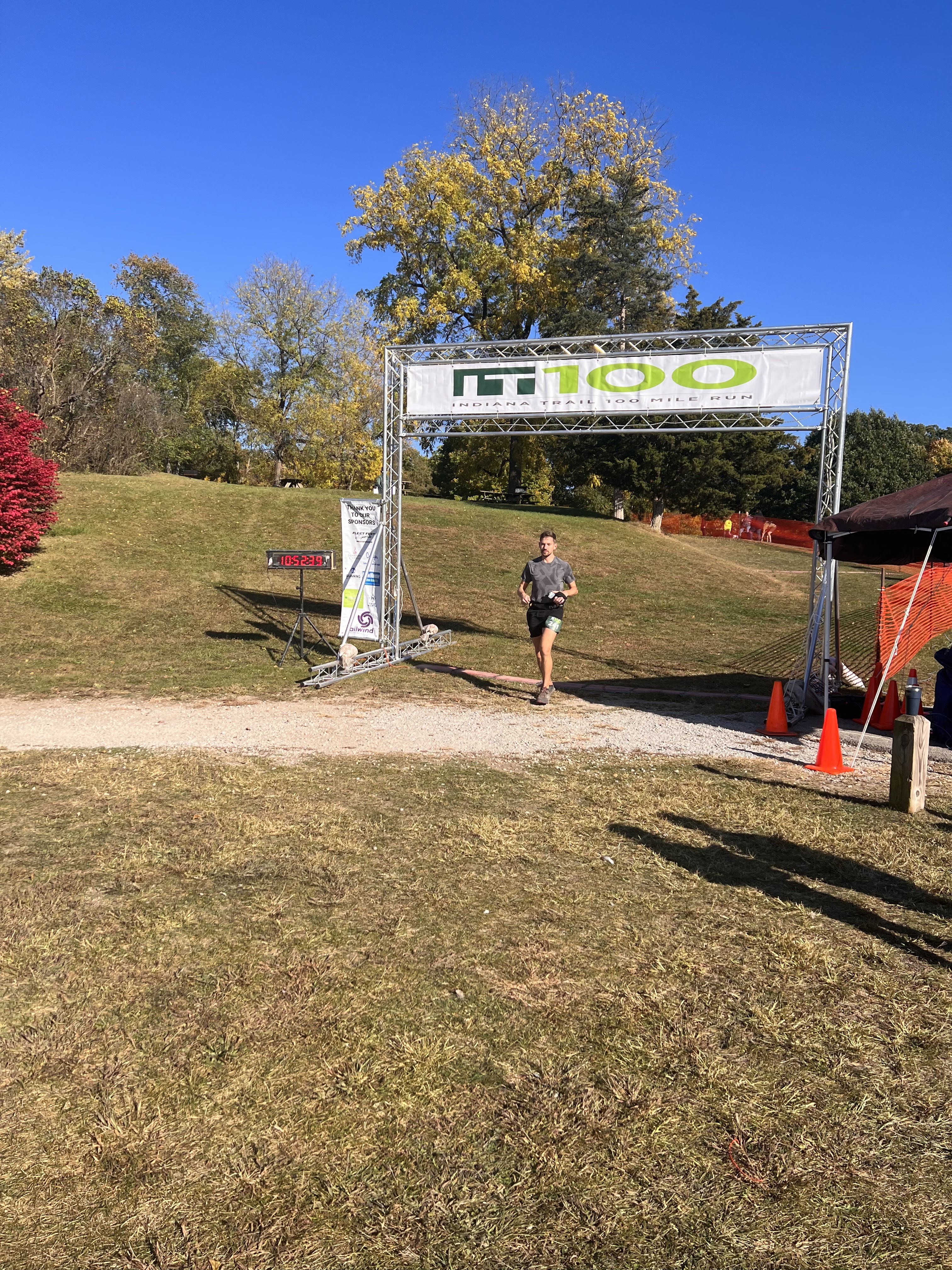
I crossed the finish line at 23:56, a few minutes ahead of the 24-hour mark. I was stunned. "Are you okay?" the race director asked me. "Yeah," I said. "I just never did that before." I almost teared up. 

I was proud of myself for pushing so consistently, and not to mention for getting everything else right that day: moving through aid stations quickly, navigating my drop bag like a Nascar pit crew, remembering to tell my mom I was happy to see her when I did. I had just the right amount of clothing, and I even had spare batteries for my lights. 

The race was fantastic, and fantastically managed. I'd recommend it, particularly as a first 100 for anyone. The 25-mile loops were beautiful and the trail was smooth sailing—beautifully maintained. The aid stations were well-placed (about every 4 miles) and well-stocked, and the volunteers were so helpful. My only source of stress, if you can call it that, was trying to find a patch of cell signal to send my sister a Snap so we wouldn't lose our streak. And once I managed that, the rest of the day was a breeze. 

I finished 37th of 130 finishers. I'm writing this a week after finishing, and I feel good. My right Achilles is still a little swollen, but I was able to go for an easy recovery run yesterday and today. Already dreaming of the next one.

Things that worked for me: 

  • Trail Toes cream – no blisters! I applied it once at the start and then when I changed socks at mile 50.
  • Xoskin socks – toe socks!
  • Naked belt – This was my first race with this belt, and I loved it. Tons of space to hold gummy bears and M&Ms.

Getting ready to start! It was in the 30s and dark, and I didn't want to get too cold before the start


Starting line


Coming in at mile 50

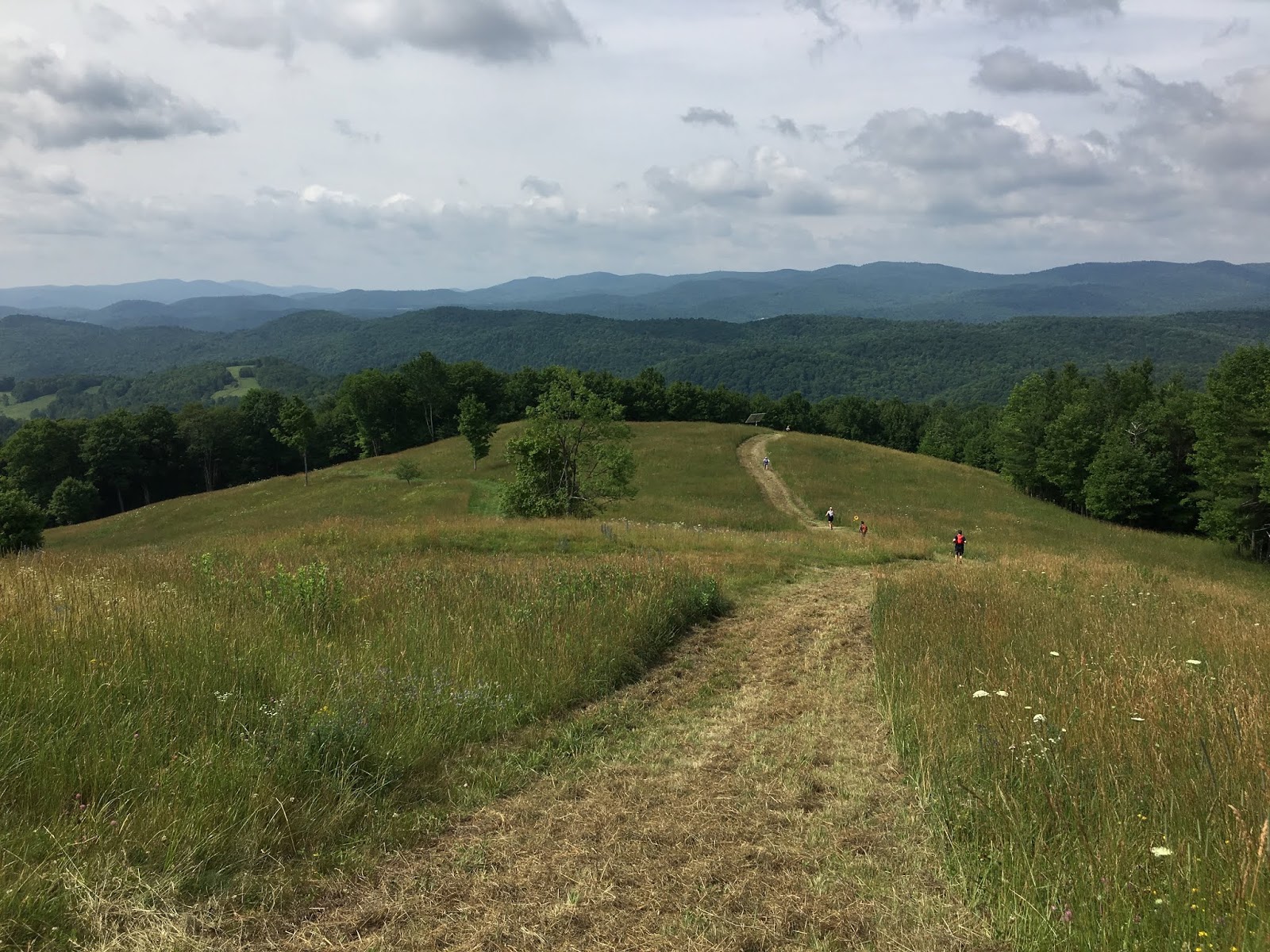
Typical view on the trail


One of the many lakes at Chain o Lakes

Kept my candy supply close to hand

Especially in the evening there were lots of furry caterpillars to avoid

Late afternoon

The trail at night

View of the finish line from mile 99.5. Just a few minutes left... 


Thursday, September 15, 2022

DNF at the 2022 Pine to Palm 100

Twenty miles in and I'm already exhausted. It's not supposed to be like this, but I guess a 10-mile-long climb to start the race will do that. What kind of stupid hobby is this? I think back to the first 100 Mile I finished back in 2015—then I was exhausted by mile 25 and went on to finish (granted, it took almost 32 hours), and so maybe I can do it again. 

It wasn't to be. Though I did the first 28 miles at a comfortable pace just under 14 minutes a mile, I gradually slowed. The cutoffs caught up to me: I cleared the mile 41 aid station two hours ahead of the cutoff; I left the mile 52 aid station an hour ahead of the cutoff; and then I came into the mile 66 aid station five minutes after the cutoff. 

The race was a grueling, if beautiful, 20 hours in the mountains. I have to say, with a little shame, that I didn't enjoy much of any of it. There were a couple moments of brilliance: the way, at sunrise, the light threw orange patches across the pine forest floor; the relief of seeing a food tent after an interminable climb; the full red moon. But mostly it was misery. The highest temperatures ever recorded in the area, a bit of smoke lingering in the air from a nearby forest fire, long exposed stretches in the sun, the dry air and altitude I'm not used to (coming from humid, sea-level Philadelphia), and of course the climbing—the race had 20,000 feet of vertical, nearly all in the first 66 miles. (So I'm glad to say that, even if I didn't finish all 100 miles, I did get all the climbing under my belt!)

I thought about dropping out all along the way, particularly during those long climbs. Funny how once I hit level ground I started to think I'd be okay. But in the end the decision got made for me. Or did it? Now, days later, I find myself wondering if I could have just pushed a little harder, gone just a little faster, made that cutoff, and then gone on to finish. The distance of time makes you forget. 

Some regrets: My brother Charlie was planning to pace me, and I was meeting him at mile 66. Because I was by then hours behind schedule, he jogged down the mountain to find me around mile 62, and we walked up together. So he did get some nighttime mountain "running" in, but I still feel bad that things didn't go as planned. And then there's the fact that I probably won't get a Western States qualifier in this year. I DNS'd Laurel Highlands back in June because of an injury, and now I DNF'd Pine to Palm. The only remaining qualifiers I could conceivably do have a long waitlist (but of course I still added myself to two of them). 

Somewhere along those 66 miles I told myself I'd never run again. It's no fun, anyway. That must have been during one of the climbs. Of course I'm going to run another 100 as soon as I can. 

I recall the words of the grizzly, seasoned ultrarunner, an older guy, who drove me and my brother down the mountain after my DNF. "Yeah, you never know how it's gonna go," he said. "Every day is a new adventure."

Midmorning in the mountains

Poison oak along most of the trails. I did my best to avoid it, but as I learned a few days after the race, I failed at that.

One of the exposed climbs

At the mile 50 aid station, instead of just letting me die like a normal person, they made me run a mile up the mountain, retrieve one of these flags, and then run back down to the aid station.

Morning light catching on the trees


Friday, August 20, 2021

Lean Horse 100

 A couple years ago, a friend told me about an out-and-back 100-mile race in South Dakota, a slow incline on the way out and then a slow decline on the way back. Sounds good, I always thought. But the race wasn't a Western States qualifier, and I never managed to make it a priority. 

I ran my 2020 WSER qualifier (Bandera 100k) just before the pandemic, and because of how things unfolded, that same race will be my qualifier for 2021's lottery. With that, I looked to non-qualifier races to run this year—and in states I hadn't run in before. I attempted a 100-mile in North Carolina in March but DNFed, and I was looking for a race to run in summer. Finally, it was time for Lean Horse.


At packet pickup the day before the race

Training for this one went well. Back in May I started getting an Achilles injury, so I dialed down the mileage for about a week and then wore shoes for some runs rather than my usual sandals. After that, I was able to build up to 70+ miles a week and maintain that without trouble, taking down weeks every so often. 

Planning was another sort of endurance quest. Sometimes I make a short weekend trip out of a race, but this one turned into a weeklong family vacation. There was a lot of confusion around who was coming, how much things cost, etc., but we got through that. In the end, thirteen of us moved into a big, remote cabin on a bison ranch in the Black Hills just in time to see the Perseid meteor shower after dinner on the first night, and we had a few days for sightseeing before the race.

Me and family before the start

Awaiting the start of the race

The Lean Horse course wasn't exactly as my friend advertised it. It was an out-and-back, and it wasn't technical, but the climbs were up and down in both directions. Even though the climbs are all at about a 2-percent grade, it starts to gnaw at you after 10 miles of ascent, especially when you've already run 50+ miles. 

The field shortly after the start

Typical view: lots of pine trees

One thing I really appreciated about the race was its noon start. I'm a creature of habit, and being able to wake up naturally in the morning and enjoy my normal routine helped keep me calm. The downside of the noon start: The first segment of the race was out in the heat of the day. It was sunny and in the high 80s, and I was feeling it. Not to mention the elevation (only one mile above sea level, but I live and train at sea level) and the dry air (I'm used to humidity). But I made do with my sun runner cap, ice in my neckerchief and lots of water. 

It's usual for me that miles 20–30 are the hardest. It feels like I've run a long way, and there's still unimaginably long to go... and it gets to me. On this race, this was compounded by the heat, and the blues came as early as mile 15. But I saw my family unexpectedly around mile 20, and that was a big cheer-up. After that, I played race-the-sun to hit the mile 38 aid station before nightfall (where I had my nice new waistlight). 

As the race progressed, I made pretty good time. My stretch goal of a 20-hour finish became quickly unrealistic, but through mile 60 or so I was on track for a 22-hour finish. I saw my family once again near nightfall, and I was leapfrogging with a fellow runner throughout practically the whole race. I had coffee a few times and put peppermint oil near my nose to help wake me up... but by 3 o'clock in the morning I was pretty drowsy. Shortly after that, the extended inclines started getting to me, and by mile 70 I could run very little. I tried to hang on for dear life, but I had to walk more and more as the temperature climbed. I felt disoriented and desperate for sleep. 

The trail just after sundown

View in the night

My family visited me again at mile 90, by which time I was reduced to a slow but steady walk. My mom volunteered to walk it in with me—and though I was crabby at the time, I appreciated it. A couple hours later, I made it across the finish line, just past hour 25. 

Dawn

Me just after finishing

I was disappointed with myself for losing track of my pace toward the end and having to walk so much, so it was difficult to be happy with the fact that I finished and didn't DNF. And this in perhaps Lean Horse's most difficult year: Historically, Lean Horse has few DNFs compared to most races; this year, though, nearly half the field dropped (37 of 90 registered runners either DNF or DNS).

In all, it was a full experience: highs, lows, beauty, pain, friendship, love... everything you'd want from a 100-mile race. I'm proud to have this base to continue my training, and I look forward to the next race. 

Wednesday, July 24, 2019

Vermont 100 Finish

This weekend was my second attempt at Vermont 100, and I'm happy to say I finished.

Solo finisher's cup, local apple cider jelly (from Mom), and buckle, atop the finisher's shorts
Vermont is not a technical race by any stretch (I'm not sure if it even properly counts as a trail race, as most of it is on dirt roads), but it's a punishing course. 17,000 feet of ascent (and descent) is nothing to snivel at, and Vermont is humid. And this year, we had the added benefit of the race occurring on the hottest day of the year. The temperatures were in the upper 90s, with a heat index over 100. And there wasn't much reprieve at night, though the temperature ostensibly dropped 20 degrees.

At the pre-race meeting, race director Amy Rusiecki shared some advice: Don’t be a hero. Be a finisher. It's something I've heard before—we all have—but I found it especially inspirational on this day, in the heat. My dreams of finishing under 24 hours went out the window by midday, and it would have been easy to get discouraged. Or, on the flipside, to try to catch up and burn myself out. Both would have led to another DNF, and I didn't want that.


That said, besides slowing down, I didn't face too many difficulties in this race. It definitely went better than my last attempt at VT. I didn't think about dropping out at all, which is unusual for me. The biggest problem was being wet for 27+ hours, which caused chafing in every unspeakable place, even in my usually-silver-bullet Saxx shorts. Besides this, it stopped me from taking many photos, since my phone and hands were always wet.

For my training this time around, I did the 12-hour at Dawn 2 Dusk 2 Dawn again back in May, where I covered 58 miles on the track. After recovering from that, I did 20 miles and 10 miles almost every Saturday and Sunday. I made sure to work in some hill training (difficult here in Philadelphia), which I did in West Fairmount Park (repeats up and down a 1/2-mile hill) and on the treadmill (hiking for 30 minutes at a time with the incline at the max of 15 degrees). And of course strength training (power lifts) 2–3 times a week, as usual.


Big thanks to my mom, my sister, and her boyfriend Erik for coming to see me a couple times along the route. That was unexpected! It's always heartening to see friendly faces... even if I don't always act like I appreciate it in the moment.

Before the race we visited the King Arthur Flour factory and shop... and afterwards we visited the Ben & Jerry's factory. A great weekend!

Me and a snail at Ben & Jerry's

At King Arthur Flour, pre-race


Gear:

  • Shamma Mountain Goat sandals
  • Reguard compression tabi socks (I put these on around mile 70, as the dust was causing the straps of the sandals to be abrasive.)
  • Orange Mud endurance pack (Overall I like this pack, though the straps are a bit uncomfortable at times, and it feels heavy and wet on my back after a while.)
  • Orange Mud handheld (I switched to this at mile 88, since I needed less water at that point, and it was such a relief to have the pack off my back!)

Heat strategies:

  • My biggest thing in this race was wrapping a handful of ice in a bandana, and keeping this around my neck. VT has pretty frequent aid stations, so I was able to replenish this every 4 miles or so. It took extra time, but it was necessary. (Though one aid station, Stage Road, was out of ice when I got there!)
  • I wore a desert ("sun runner") cap with curtains on the back and side to create some shade. While this was a bit uncomfortable at times with the humidity—it felt pretty stuffy—it definitely kept me cooler under the sun. It had the added benefit of keeping away the deer flies, which were bothering everyone else. 

New things:

  • When I was tired, I took some peppermint essential oils—the Doterra beadlets are great. They woke me up immediately. I was surprised! Better than coffee. New secret weapon.


Friday, November 2, 2018

Javelina Jundred 2018

I tried my hand at the Javelina Jundred 100 Mile back in 2016, but I DNFd after two loops (about 40 miles) because of the heat. I remember walking the 10 miles from Jackass Junction back to the start/finish area, very slowly, with my heart beating like it would for a tempo run. I was exhausted.

Bourbon at an aid station. I was not so brave, but I love the idea!

After trying a few other hot-hot ultras, I decided that running in the heat wasn't for me. I didn't plan on coming back to Javelina. But this year I needed to do a Western States qualifier ("needed"), and I DNFd at Quebec's Ultra-Trail du Harricana because I was going too slow for the cutoffs. Comparing the remaining qualifying races of 2018 with my personal schedule, it turned out that returning to Javelina was my only hope.

Packet pickup on Friday

I was more or less well trained, but I was also extremely stressed out from my new teaching job and fall travel schedule, and I went for it. I arrived in Phoenix on Friday, checked in to the race, and then ate as much as I could and walked as little as possible while hanging out with my friend Jake, and then hoped for the best on Saturday morning. I planned to go out with Wave Two (expecting slower than 24 hours), but at the last second I joined in with the back of the pack of Wave One.

Watching Wave One start. I was going to just watch, but at the last second I joined in.

In the race, I started feeling fatigued earlier than usual, around mile 10. Whenever this happens, I think back to my first 100 mile finish, where I was dead-tired by mile 25 yet still managed to finish. If I could do it then, I could do it again, I thought. I was determined to finish.

I've grown as a runner since 2016, particularly when it comes to heat. This time I came in with a good heat management strategy. I wore arm sleeves, a bandana around my neck, and a microfiber towel over my head, all of which I stuffed with ice at every aid station. I drank as much water as I could, which was aided by the wonderful pack I got this year from Orange Mud (holds 2 liters!). As a result of all this, I never actually felt hot, and I never ran out of water. It was great. The only downside was how heavy all this was—but I couldn't do without it.

My desert running getup

Exceeding my expectations, I was on track to finish in under 24 hours for most of the race. I hit 50 miles in around 11 hours, and I felt as good as I did at mile 10—and things seemed like they'd stay well enough at that pace.

Then around mile 75, something bad happened. I managed to get a sizable blister on the ball of my foot, edging toward my toes. It popped of course, as it bore my whole body weight with every step, but that only made it hurt more. I changed socks, but I think that actually made the pain worse. I'm not sure what caused this, but it may have been the combination of compression socks and sandals that I was wearing. I'm starting to wonder if sandals may not be the best idea for a 100-mile run—at least the whole thing. I'm pretty heavy as far as far as runners go (usually around 190 pounds, plus my gear), and having that weight pounding down, especially when it's rocky, with no padding can add up after a while.

In any case, after mile 80 every step was excruciating. It reminded me of the end of the Pistol Ultra a few years back, where my feet were extremely swollen and I felt like I had a stress fracture in my metatarsals. Each step was the kind of pain that makes you feel like you might pass out. It made me scowl and tear up a bit. I tried to enter into the pain, and it wasn't really all that bad after all. I could deal with it. Again, I was determined to finish.

Alas, with the blister issue and my increasingly tightening muscles, I could run very little of the last loop—maybe only one mile of it in total. As a consequence my time slipped, and I ended up finishing in 25 hours, 38 minutes. Still not so bad!

Such amazing views, which smartphone cameras can't really capture

All in all, I loved this race. The desert was surprisingly beautiful. My friend Sonya said it was because they'd been having a lot of rain recently (and unseasonably), which made everything green again. There were even some flowers. The sunrises and sunset were gorgeous—the deepest marbling of unexpected colors. I heard songs from crickets, birds and coyotes at various points throughout the race, and I loved watching the constellations trek across the sky (in Philadelphia you can see about three stars on a clear night). I also loved Jackie O, who was dancing at the turnaround point all day and all night, giving ice-water sponge hugs and encouragement throughout the race. Yay!

Jackie O at the turnaround. Photo by Aravaipa Running.


Monday, September 18, 2017

Hallucination 100 (Hallelujah, I Finished!)

I was starting to think I'd never finish another ultra. I got hurt sometime after last year's Via Marathon—too much, too soon after a hard (crash-and-burn) effort—and my 2016 season fizzled out with a DNF at Javelina Jundred and a slow-but-fun Philadelphia Marathon with Students Run in October and November, respectively.

But my heart lies with 100 mile races now, and not being able to finish Javelina was a real bummer. I had my sights set on Lake Martin 100, but still by mid-December I couldn't run without piercing pain going up my left lower leg. I wrote the race director, and he agreed to let me defer my entry to the 2018 race. (Bless him!) In the meantime, I was signed up for Dawn to Dusk to Dawn 12 Hour in May and I got myself in Vermont 100 in July. Surely I'd be healed by then... 

I wound up stopping at D3 after 8 hours (50k); pain started after two hours of blissful running, and it slowly got worse. I walked a lot so as not to break myself, but I called it quits before too much longer. By the time Vermont 100 came along, I was pretty confidently running 40+ miles a week and my injury was mostly at bay, but I just didn't have enough training under my belt to finish such a hilly course. 

So it'd been over a year since I finished a 100 mile, and the Western States lottery was nearing: To keep the lottery tickets I'd built up in previous years, I'd need to finish a qualifying 100-mile race before November. Time was ticking. I decided to do one in September, and settled on Hallucination 100 because it would be reasonably easy to get to and would hopefully be a doable course. It was a 16.66-mile loop course—my favorite format. It also started at 4pm on Friday, which meant I'd encounter nighttime much earlier in the race than normal—probably for the better.

Three of my siblings, a friend of theirs and I drove to Michigan on Friday morning. My sister Selena and I drove separately and got there first, so we set up camp. The others arrived and got situated before their 3–10pm aid station volunteer shift, and I went into my tent for a quick nap before the start. 

Suddenly, it was time to start. It was sunny and our shadows were harsh, and then I was running into the woods with 150 other people. My plan was to take it slow, to try to stay steady through the whole race, and not finish any loop faster than 4 hours (putting me at a 24-hour finish). I walked up all the hills, and I just generally enjoyed myself. Life is good, I remember thinking. I was wearing sandals from the start, but soon I realized that I couldn't make out all the rocks and roots enough to avoid them (chalk it up to my poor eye acuity and everything down there being the same shade of drab). I switched to shoes, which offered more protection at the front but much less on the bottom—a catc-22 if there ever was one. 

I saw my family at their aid station at mile 8—"So you have to go 92 more miles?" my brother said—and then again at mile 24. It's always such a fun "surprise" to see people you know after a long time in the woods. By then it was dark, and I settled in for another loop and a half of darkness. I put on some music. I was surprised how well everything was going. Maybe this would be an easy 100. At the same time, I wondered if everything would stay okay, or if I would have to DNF again. One hundred miles is a really long way to go, after all.


Still feeling good... well, only 8 miles in

Hey, 16+ miles later, and still smiling. I think that's the secret. Though this time it was just because I accidentally filled my water bottle with coffee (and possibly some Mountain Dew, though I think it was water)

My sister Christina helping at the aid station

Things stayed quite good until mile 83, around 2pm. I saw my family again when I stopped by my drop bag tent (positioned conveniently right along the course), and I perhaps inadvisably bragged that I wasn't feeling tired at all. After that, I got really drowsy and a little crabby, but I kept going. I drank coffee and had some caffeinated gel packets, and I started feeling better. I slowed down a lot. The bottoms of my feet screamed, and I thought about changing back to sandals but then remembered how much more it hurt stubbing my toes. Things were getting worse. 

Somehow I persevered. I don't know how. I never do. All you can do at the time is keep going. Focus on the next aid station, the next step. Focus on where you are, don't think in terms of miles. Things are never as bad as they tend to seem. I walked less in the sixth lap than I did in the fifth, and before I knew it I was done. I finished in 26-and-a-half hours, slower than the 24 or 25 I was hoping for, but still a comfortable finish.

What happens to feet who are not prepared to wear shoes...

Teenage siblings camping... 

I had some lasagna, hung out with my siblings a bit more, and then I took a hot shower (!) and changed. It got dark. Selena brought me some Chipotle, and I took a few bites before falling asleep. I finished the rest in the morning. 

Still smiling at mile 67

Finished!

And now to eat! I had to put on a sweatshirt because I quickly got very very cold.

These things I got for finishing. The bus is because I placed (5th) in my age group!

Monday, July 17, 2017

Vermont 100 - The DNF Streak Continues

Vermont 100 has been on my mind since I first started running ultras. It's one of the nation's oldest hundreds, and in my (long and slow) quest to do a race in every state it was the first one to come to mind for Vermont. I signed up in 2016 but couldn't run because a friend's wedding fell on the same day, so I aimed for 2017 instead.


For all the mythos of Vermont 100 I'd built up in my imagination, I knew nothing about the course, as it turned out. I expected it to be a bit hilly, I guess, and green. I knew it was more or less entirely on dirt roads. Understatements.

I approached Vermont 100 on a long DNF streak. The last ultras I finished were Zion 100 in April 2016, the 12-hour at Dawn 2 Dusk 2 Dawn in May, and then a small, New Jersey 50k in June. The next month, I DNFed at Big Butts 100k (in Mississippi, due to the heat). Then in September I got a major injury that I think was a stress fracture in my left fibula, and I couldn't run for most of September and October. At the end of October I attempted Javelina Jundred, notwithstanding that I hadn't run since my marathon six weeks prior. I DNFed at mile 40 from what I described as heat exhaustion. It was in the 90s and pure sun, sure, but perhaps part of my problem was not having run sufficiently in training. I took off for a while then (except for running the Philadelphia marathon-and-a-half weekend in November), and didn't run at all in December. Starting in January I eased back into the elliptical, and then in March I started running. My next ultra was the 12-hour at Dawn 2 Dusk 2 Dawn in mid-May, where I had to call it quits after 8 hours (and I stopped running after 2 or so) because my injury was flaring up again.

Finally, starting in June, my running became consistent enough for me to go longer, and by the end of the month I was up to 50-mile weeks and I'd done two 20-mile runs. I had been focusing on building volume, and I only dedicated a very little bit of attention to hill training. I felt a bit undertrained for a 100-mile, but I thought it might be enough for a finish. To my credit, though, I'd been doing weightlifting three times a week and making consistent gains there: my one-rep max for squat is about 208 pounds; for deadlift 370; and for bench press 163.

In the last pre-race email, the race director warned of mud. It's been a wet spring in Vermont, she said. Since I run in sandals, mud is a big worry for me. If there's just a little, it's fine, but if there are long stretches of wet and unavoidable mud, all bets are off. I brought my pair of shoes just in case, but it wasn't until after I'd left all my drop bags at the pre-race meeting that I decided to actually run in them. Consequently, I didn't pack extra socks.

Anyway, I set out wearing shoes and compression socks—when I was packing, I didn't seriously expect to be running in shoes, so I didn't bring any normal socks.

Immediately, it was a lot of fun. The race begins with a long, encouraging downhill. And the fun continued for a while. I was making great time, marching with gusto up the hills and cruising like the Batmobile down.

I first started to get worried around mile 15 when my muscles were tighter and tireder than they ought to have been. But part of ultrarunning is keeping going even when your muscles are tight and tired. For a long time, things didn't get much worse.


Soon the horses were around. One thing I learned just prior to the race was that Vermont 100 is also a horse race, and it was a fun experience running alongside horses. The aid stations were great, with some of them having homemade baked goods along with the usual fare, and the volunteers were helpful, always offering to fill my bottles, etc. The countryside was gorgeous—everything deep green, tall trees, sprawling mountainside farmland.

I heard a lot of interesting conversations. Everything from, "That's not a frog, you idiot, that's a flower," to "I think Billy died last night. I got a call from Margaret and it didn't sound good, she just said there was an emergency. I don't think she wanted to say it in a text, and she couldn't get a call to go through."


The course quickly caught up to me. It was endless hills. Virtually no flat stretches along the entire course. Several climbs that took 15 minutes or more to hike up. And I kept hearing, "It's like this to the very end." As usual I wondered often if I could make it. But I could keep going, so I did.


My muscles got tighter and tireder, and by mile 50 I was in poor shape. I had to walk more, and slower. I sure wish I'd packed some Wintercrest in my mile 47 drop bag. I hoped that if I just kept going, things would loosen up.

Long story short, the next 10 miles were the same, and after mile 60 things got really bad. I could only shuffle along, my quads stabbing with each step, and the hills had me out of breath. I had to stop and take breaks. By mile 62 I was exasperated and my legs were rock solid. I had been thinking about dropping out at that aid station for the past 4 miles, but for some reason I just kept going. Shortly after tha aid station I realized that was a bad idea. I didn't think I could even make it to the next aid station. By this point even going downhill was slow and painful.


The ultrarunning ethos says to keep going until you simply can't take another step. So long as you can take at least one more step, then you should take it. Part of me wondered if I should slog onward through the night, for the next 14 hours, at this pace and in this pain. But some quick math showed me that around midnight I'd no longer be making the cutoffs at the pace I was going (which was, moreover, slowing).

But first I had to make it to somewhere I could drop out. By this time I was a mile and a half from the next aid station and the same distance from the prior. So I sat on a rock to gather the gumption to carry on. That's when a patrol van pulled up and asked if I was okay, and the rest is history.

Dropping out doesn't feel good. The student in me frets over the grand "waste" of money—if I paid for the registration, car rental, hotel and supplies and spent all this time coming up here, shouldn't I finish? Who have I let down? My friends and family, all the people on Facebook... myself? There's always the question: Mightn't it have gotten better? Couldn't I have finished? I'm not sure. It doesn't seem all that productive to think about that right now, because all it does is show that I already forgot how bad things really were out there at that time.

I'm also worried that I have preserved my long DNF streak. That is not encouraging. Will I ever finish another 100 miler?

For now, I'm going to resume training and do another one this fall. I'd like to keep myself in the Western States lottery (though that will be a whole nother horror if I get selected), so I signed up for Hallucination 100 in September. By then I will have time to bring up my mileage sufficiently. One good outcome from VT100 is that I think I can pronounce myself no longer injured, if I could make it 60 miles with no sign of a flare-up.

I did have a few successes at VT100, which are worth mentioning: It was hot and humid, but that didn't bother me. I think Philly acclimated me well, and I had a solid strategy of using ice (eating it, filling bandanas with it) to stay cool. I also didn't have any chafing, even though my Orange Mud quiver usually chafes my underarms (don't ask me why I was wearing it...). I never ran out of water (partly because the aid stations were quite plentiful!). I didn't have any stomach issues (more-than-usual bathroom breaks notwithstanding). And the shoes didn't bother me at all.